"The Team Should Not Be 10 People Anymore": Revolut's Nik Storonsky on AI Teams of Two, No Pass-Through Managers and a $115B Bank
Revolut CEO Nik Storonsky on AI teams of two or three, 90% automated support, removing relay-only managers, 50 direct reports and building a $115B bank.
By Tech Team Strategy · Nov 2, 2026 · 9 min read
Watch the original interview: YouTube
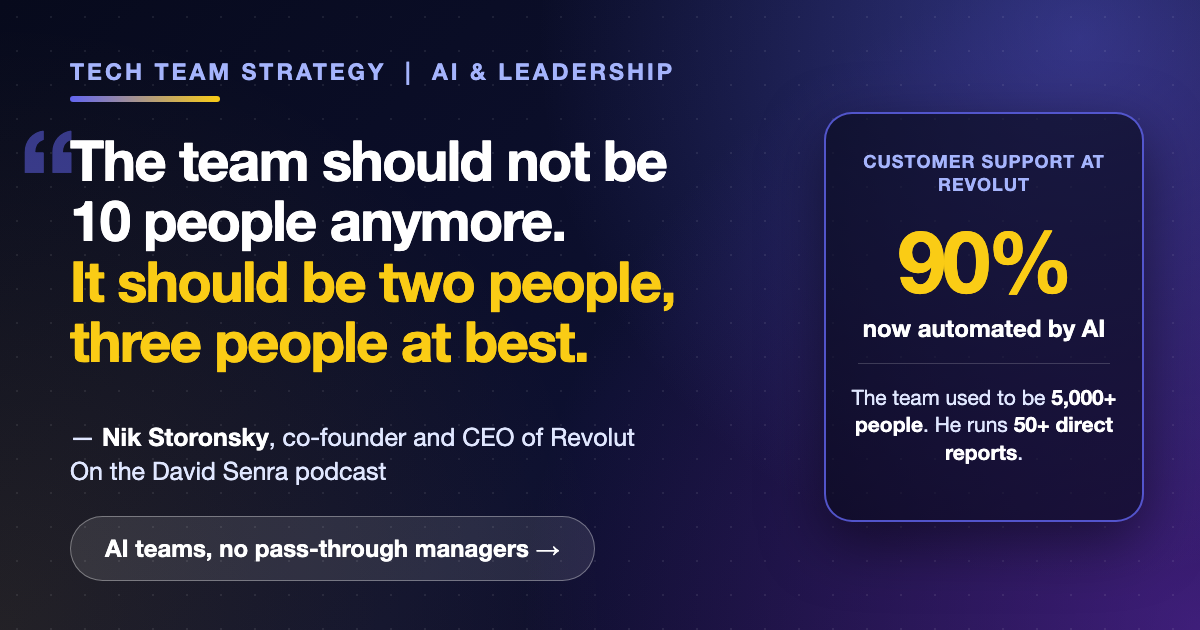
Nik Storonsky built Revolut from a travel card into a $115 billion digital bank. Now he is rebuilding it again, this time around AI. Product teams of up to ten people should shrink to two or three. About 90% of customer support is already automated. And managers who only pass information along have no place in his company. "The team should not be 10 people anymore," he says. "It should be two people, three people at best."
Storonsky, Revolut's co-founder and CEO, sat down with David Senra for a 67-minute conversation published on October 25, 2026. They cover competition, why founders beat professional CEOs, running a company like a machine, funding product bets like a trader, hiring "self-guided missiles," keeping VCs off the board, buying ads in half of Europe's airports, and the AI changes now reshaping Revolut.
This article is our own summary, written for founders and leaders. Statements below are as described in the interview and we have not independently verified them. Quotes come from the video's captions and are lightly edited for filler words and transcription errors. Watch the full video above for everything that was said, and sign in to read the full transcript below the article.
Want the full playbook? Our detailed Executive Brief on Nik Storonsky covers fifteen themes with his own quotes and timestamps, ten key numbers, a table of how AI is changing work at Revolut, a 12-point checklist and a 30-60-90 day plan.
The short version
- AI teams of two or three. One developer can now do front-end, back-end and data science, so teams of ten are too big.
- 90% of support is automated. The support team used to be more than 5,000 people. Engineers are 30% faster.
- Next: the full-stack AI employee. An agent with email and Slack that joins calls and works in back-office systems.
- No pass-through managers. Managers who only relay numbers upward add nothing, he says, and he has removed them.
- 50 direct reports. He hires self-guided people who don't need managing, and talks directly to designers and developers.
- Spread what works. When one team finds a faster AI method, he pushes it to every team.
- Fund bets like a trader. Double down on the top bets, cut the bottom quarter within 18 months.
- Founders beat professional CEOs, and investors belong off the board.
AI shrinks the team from ten people to two or three
For ten years, Revolut was built from small independent teams of up to ten people: three or four back-end developers, two to four front-end developers, a product owner and a designer. Storonsky says he spent that decade optimizing how to direct people and build an organization around their strengths and weaknesses. AI changes the math (23:34):
"I think the team should not be 10 people anymore. It should be two people, three people at best, because one developer can do front-end, back-end, can even do data science as well." (Nik Storonsky)
The change is already in the numbers (24:18). About 90% of customer support is automated; "before it used to be 5,000 people plus, now it's much less." Engineers are 30% faster. Translation and cross-selling run on LLMs. And he says "we are just in the beginning."
His next goal is not another chatbot. It is a full-stack AI employee:
"It's more like an AI employee which can join calls with you, which has email, which has a Slack account, which has access to all internal back office systems, and can do work." (Nik Storonsky)
He believes this is doable with current technology, and that "sooner or later, the majority of companies will come to" it.
No managers who just pass things along
Senra asks whether he has eliminated managers who simply pass along what to do. "Yeah, exactly," Storonsky answers (29:25). After ten years of watching them, he can't see what they add:
"They take information from individual contributors and then they pass it to stakeholders. What's their value add? Did you change direction of the team? No. Did you bring any innovation? No, not really." (Nik Storonsky)
Instead, he has about 50 to 52 direct reports, and goes deeper still: he speaks directly with designers, product owners and developers on projects (25:48). That only works with the right people:
"Whenever you hire smart self-guided people, you don't really need to manage them. You just need to show them direction, and then ensure that they're all synchronized." (Nik Storonsky)
He sorts people by how much management time they need (30:10). Brilliant people are "self-guided missiles" that find the goal and hit it. Good people need the goal but no iteration. Average people need weekly direction, and that is the management time he doesn't want to spend. "In order for you to have as many direct reports as possible, you just need to minimize management time spent on each of them."
Spot the best AI method, then spread it everywhere
Storonsky calls this his strongest skill: finding an innovation in one team and spreading it across the company. His latest example is AI in design (26:59). One team uploaded Revolut's code-level design system to an LLM and prompted it to produce flows. Instead of static Figma frames, they got a live interface you can click through, made three to four times faster. He is now pushing that method to every designer.
Standard tools matter: "You don't need every single team or department to reinvent their own bicycles."
Founders versus professional CEOs
His edge over legacy banks is simple: they are run by professional managers who stay three or four years, collect bonuses and play defense (6:18).
"Professional CEOs, ultimately their goal is not to improve the organization. Their ultimate goal is to protect their job." (Nik Storonsky)
Those managers avoid the risky work of replacing old core banking systems, and many are not technical. "Banking is not only about regulation, it's also about building tech. And I think all these people are very bad at building tech."
Run the company like a machine, and fund bets like a trader
Storonsky pictures the company as a machine: people, structure and process go in, a product people use comes out. When speed slowed as the team grew, he split work into small independent teams on one platform. Then he built regulatory affairs, then a recruiting machine. "You identify the problem, you solve the problem, you go again."
From his years as a trader he brought risk management and metrics. KPIs, he says, "kill politics" because everything is transparent. Every new product is a bet: a small team builds it in 9 to 18 months, then growth in gross profit decides (20:32). Bets in the bottom quarter are shut down. The best get a second team, a third, then become a department. He doesn't trust his own instincts: "historically I was wrong so many times."
Hiring: top-1% people early, not experienced executives
Investors told him to hire experienced executives. Of more than 50 he hired in the first five years, he kept two (45:26). Executives have a prime, like athletes, and there is a negative selection bias: the very best have already made it. He hires people in the top 1% of career progression at 25 to 30.
He also lets average performers go, which he says many good executives struggle with because they care more about being empathetic than about winning. "Likable is never the goal for executives," he says. The goal is to hit the target with the fewest resources.
Too much money, and VCs off the board
He thinks Silicon Valley has a culture of "trying to solve problems with money rather than with your brains," like hiring an expensive VP of sales with 50 reps before building a cheap sales system. Europe's capped and fragmented market forced Revolut to fight its way from negative gross margins to about 80%, and that taught it to compete.
On investors, he is blunt. Early backers demanded board seats and control; one pushed him to fire his best person for being too hardcore. He refused, and removed VCs from the board in every round since (48:14): "You always need to have operators rather than VCs on the board." He even started his own fund, Quantum Light, which picks startups with machine learning models. Its first $250 million fund reports a 56% IRR.
Trust, airports and an unstoppable machine
Revolut spent nothing on marketing for seven years. Then Storonsky hired from gaming companies, the biggest and most careful ad spenders. A digital bank has no branches, so it has to earn trust. His answer is to buy cheaper impressions in the physical world: ads in about half of Europe's airports and a Revolut store in Barcelona. The long-term plan is cash flow big enough to fund moonshots, starting with Pragma, a transformer model trained on billions of Revolut transactions.
"With time it can become an unstoppable machine, because it provides much better products and services at a much better price compared to local banks." (Nik Storonsky, at 1:05:14)
What to do with it
- Count the relay layers. List every role that only passes information up, and ask what each adds.
- Run a two-person test. Pick one product team and see whether two or three people with AI can match ten.
- Measure support automation. Find what share AI could resolve today and set a target.
- Spread your best AI method. Find the team using AI best and roll its approach out to everyone.
- Put numbers on bets. Give every product a growth metric and a date to cut it.
- Hire for self-guidance. Judge people by how much management time they need.
- Set clear AI rules. Our AI Policy Pack gives your team clear rules for using AI tools safely.
Get the detailed Executive Brief
Our Executive Brief: Nik Storonsky on AI Teams of Two, No Pass-Through Managers and Building Revolut goes much further than this article:
- How AI is changing Revolut's team structure, in his own words
- Ten numbers worth remembering, clearly attributed
- Fifteen themes explained, each backed by short quotes with timestamps
- A table of how AI is changing work at Revolut
- A 12-point checklist, six questions and a 30-60-90 day plan
- A quote bank of 20 more lines and a timestamped chapter guide
Video details
- Title: Competition, Intensity & Building a $115 Billion Global Bank | Nik Storonsky, Revolut
- Host: David Senra, host of the David Senra podcast and Founders
- Guest: Nik Storonsky, co-founder and CEO of Revolut (X, LinkedIn)
- Channel: David Senra on YouTube, about 144,000 subscribers
- Published: October 25, 2026
- Length: 1 hour 7 minutes 2 seconds
- Audience (as of November 2, 2026): about 129,000 views and 1,500 likes
- Category: People & Blogs
- Official description (excerpt): "Nik Storonsky is the co-founder and CEO of Revolut, a digital bank valued at $115 billion that is available in 38 countries." It covers why founders have an edge over professional CEOs, funding product bets algorithmically, hiring self-guided people, keeping VCs off his board, and how AI is changing the way Revolut is organized.
- Sponsors: Ramp, Deel, AppLovin
- Show notes: davidsenra.com/episode/nik-storonsky
- Watch: youtube.com/watch?v=hT_MAAwFLIc
Chapters
- 00:00:00 Coming for Jamie Dimon's dinner
- 00:02:04 Building the #1 bank in 100 countries
- 00:06:12 Why founders beat professional CEOs
- 00:08:45 Revolut's biggest mistake
- 00:12:47 Why legacy banks can't innovate
- 00:17:20 Running a company like a machine
- 00:20:28 Funding winners and cutting losers like a trader
- 00:23:31 How AI is changing Revolut's team structure
- 00:25:23 50 direct reports and spreading innovation fast
- 00:29:59 Hiring self-guided missiles
- 00:33:31 Too much money makes founders weaker
- 00:37:38 What Europe's constraints taught Revolut
- 00:41:08 Why VCs are like football cheerleaders
- 00:49:28 Starting a fund to compete with VCs
- 00:54:28 From zero marketing to buying Europe's airports
- 01:00:21 Funding moonshots like a global tech company
- 01:03:58 Building an unstoppable machine
Want to put this to work?
We help founders and leaders build strong teams and put AI to work across the company. Book a free call or see our services.
Originally published by Tech Team Strategy
Get the briefing
The week's essential stories, free in your inbox.