"Your Pay Has Nothing to Do With Your Performance": Colin Lernell on Negotiating Tech Salaries, Managers and $2M AI Offers
Salary negotiation expert Colin Lernell on why pay isn't about performance, why your manager matters most, $2.5M AI offers, and negotiating without a competing offer.
By Tech Team Strategy · Nov 2, 2026 · 9 min read
Watch the original interview: YouTube
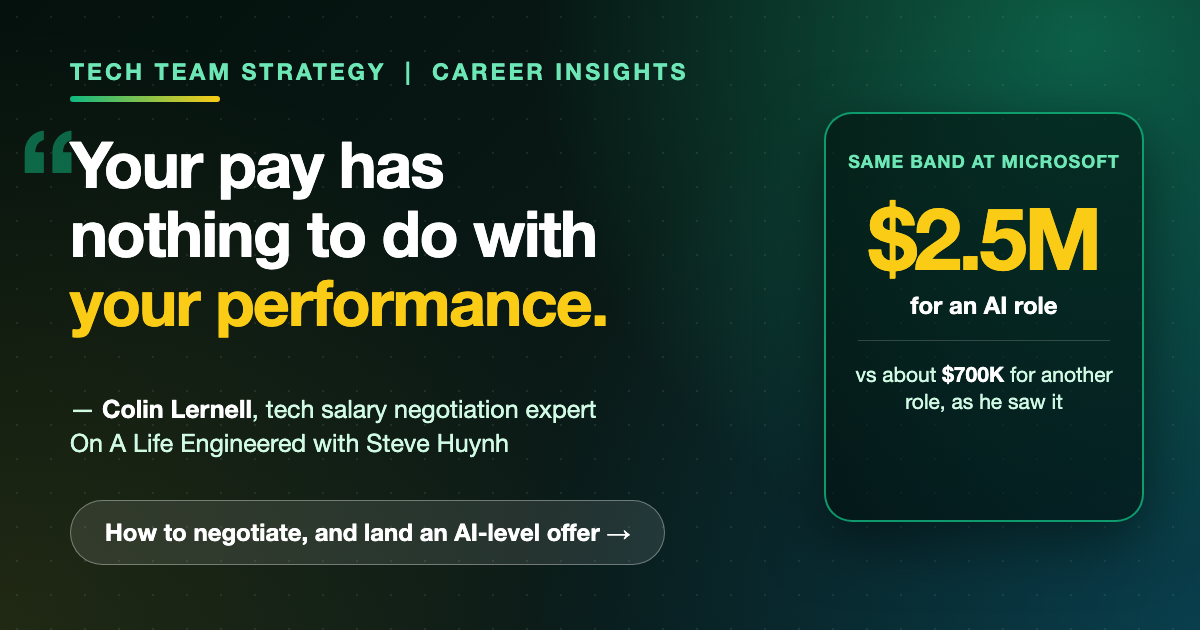
Most engineers believe their pay reflects their performance. Colin Lernell found out otherwise early in his career: the worst performer on his team was earning about $120,000 a year more than the best. "Your pay has nothing to do with your performance," he says, and he has built a career on that lesson.
Lernell, who coaches tech workers from senior engineers to executives with seven-figure packages, sat down with Steve Huynh of A Life Engineered, a former 18-year Amazon engineer, for a 68-minute conversation published on August 17, 2026. They cover the "secret menu" of tech pay, why your manager matters more than your paycheck, the $2 million-plus AI offers, and how to negotiate without a competing offer.
This article is our own summary, written for tech workers and for the leaders who hire them. Statements below are as described in the interview and we have not independently verified them. Short quotes are lightly edited for filler words and transcription errors. Watch the full video above for everything that was said, and sign in to read the full transcript below the article.
Want the full playbook? Our detailed Executive Brief on Colin Lernell covers fourteen themes with his own quotes and timestamps, twelve key numbers, who decides your offer, a six-move playbook, a 12-point checklist and a 30-60-90 day plan.
The short version
- Performance is a small part of pay. Expertise a company wants, its pay philosophy, timing and how critical the role is matter more.
- Your manager matters more than the paycheck. The hiring manager can unlock a better offer, and decides whether you get promoted later.
- AI has its own pay scale. He has seen $2.5 million offered at Microsoft AI for a band that pays about $700,000 elsewhere in the company.
- You don't need a competing offer. Four out of five of his clients don't have one. Real opportunities are enough, and you can create them in a day.
- "Final offer" is rarely final. It means final unless someone approves an exception.
- Ask for one number, not a range. Companies look at the bottom of a range.
- At startups, negotiate the prenup, not the divorce. Ask about equity terms before you sign.
Your manager decides more than you think
This is the thread that runs through the whole conversation. Lernell's first big lesson came from watching executives negotiate: after an offer, they went into due diligence mode and asked to talk to the hiring manager, the skip manager, even a board member (4:45). Those managers then fought for them, with title bumps, more money and more equity, often without being asked.
"Behind the scenes, there is a whole team of people outside just the recruiter who are involved in what your offer ends up being." (Colin Lernell)
The due diligence call is also a preview of your future boss (29:41). Is your project the top priority? How do they give feedback? At the end, say you'll work with HR on the details and hope to count on their support. If the manager shrugs, that tells you a lot:
"If you have a manager who doesn't know how to do the politics in those calibration meetings when they're doing promos, you're never getting promoted, even if you do a good job." (Colin Lernell, at 31:37)
Steve Huynh agrees: the relationship with your manager is the most important one at work, and "a paycheck doesn't solve" a bad one. Lernell sees it every day: people changing jobs are "running away from their old job, and it's almost certainly the manager."
AI pay: go where your skills are overvalued
AI has created a separate pay scale inside the same companies. "Microsoft AI can probably pay two, three times as much as any other role at Microsoft for the same band," Lernell says (28:12). He has seen $2.5 million offered for a position that pays about $700,000 to someone else. Big tech companies hiring people from OpenAI and Anthropic offer 1.5 to 4 times the usual package, with approvals going up to the CEO.
"You want to go to where your specific skill set is overvalued." (Colin Lernell)
But AI money comes with risk. One client, retrained in AI, had an offer worth $1 million a year more at another big tech company. Lernell found red flags: skills not yet proven, back-channel reports of a micromanaging boss, a company under pressure in AI with seven-day weeks, and no trust built up yet. The current company countered with a promotion. The client stayed, and within three or four months was earning as much as the outside offer.
Why pay has so little to do with performance
What actually sets your offer, in his words (10:17):
- Expertise they want to buy. "They want the highest probability of a great outcome with the least time and effort." Someone from the company that leads in an area is a shortcut, even if not the best on that team.
- Compensation philosophy. Some companies pay at the 25th percentile, others at the 80th. The same job can pay "2, 3, 4 times as much" at a different company, org or city.
- Timing. When Meta turned stingy for six months, he told senior engineers to wait. Six to nine months later, they got 50 to 100% increases and director-level offers.
- How critical the role is. If the hiring manager pitches it as critical internally, budgets open up.
Interviews still matter: a strong result gives the hiring manager the justification to fight for you. But, as he puts it, "performance is just such a small part of it."
Be your own executive assistant on the offer call
Even after years of coaching, Lernell nearly lost a $2 million offer by reacting emotionally to a number far below what he expected (17:05). It turned out to be a miscommunication. His advice now:
"If you go into an offer call, pretend you're your executive assistant. Don't pretend you're yourself." (Colin Lernell)
Be friendly, gather facts, clarify the numbers, and never decide on the call. Say you need to review it with your family. Then follow up with the hiring manager: here is what I'd be walking away from; if we can close this gap, I'll sign.
"Final offer" is rarely final
"Final offer is not final offer most of the time, and it's not because they're lying" (20:25). The recruiter may really be at their limit, but they don't have all the information: the equity and bonus you'd give up, your other opportunities, or how critical the hiring manager thinks the role is. Send a clear written case and ask them to take it back to the committee. That often unlocks a sign-on bonus, more equity or a higher level.
You don't need a competing offer
"It's a big myth that you need to have competing offers" (37:35). What you need are real opportunities. One client who had interviewed for seven months messaged three or four people at competing companies asking for career advice. By the next morning, they had three replies, including an introduction to a leader hiring for the same role.
Then tell the company you are in process elsewhere, and that if they offer a specific number, you will sign and end those processes. Ask for one number, not a range: "Be specific and confident in it... Not a band, not a range" (41:58).
Retention offers and deadlines
- Retention: tell your manager you're leaving before you ask for money. How they react shows how much they value you. Fewer than one in four retention offers are really good, but it's worth trying.
- Deadlines: ask the recruiter for a few more days, then ask the hiring manager directly. Keep a side channel (text, LinkedIn or email) with the hiring manager through the whole process; it also helps you avoid "silver medal syndrome."
- But deadlines can be real. One candidate assumed an extension, missed the deadline by two hours, and lost the offer. "If you don't get a confirmation in writing that the deadline is extended, don't assume it's extended."
Negotiate the prenup, not the divorce
Remote work exceptions happen when the hiring manager badly wants you, even after the recruiter says it's impossible. At startups, read the equity plan: about three quarters still give you only 90 days after leaving to pay to exercise your vested options. One chief product officer had to put down nearly $1 million. Ask about the exercise window, severance and change of control before you sign (1:01:18).
"It's much easier to negotiate the prenup than it is to negotiate the divorce." (Colin Lernell)
If you are the one hiring
The same lessons apply from the other side of the table:
- Your pay philosophy decides who you can hire. At one company, a 25th-percentile policy left top roles empty for 8 to 12 months.
- Expect strong candidates to ask for the hiring manager. That conversation is your best closing tool.
- Pressure deadlines backfire. Nine out of ten candidates now say they would accept an offer and keep looking. After companies rescinded signed offers in 2022-23, loyalty has to be earned.
- Clear AI and data rules help you hire. Our AI Policy Pack gives your team clear rules for using AI tools safely.
What to do with it
- Know what you're selling. Write down the expertise a target company would pay to shortcut.
- Find the payers. Research which companies and teams pay at the top of the market for your skills, including AI teams.
- Do the due diligence call. Talk to the hiring manager after every offer and judge whether they'll go to bat for you.
- Prepare the call. Talking points, questions, and a polite way to end it without deciding.
- Create options. Ask three or four people at competing companies for career advice this week.
- Ask for one number. Tie it to what you'd walk away from.
- Get it in writing. Extensions, exceptions and equity terms.
Get the detailed Executive Brief
Our Executive Brief: Colin Lernell on How to Negotiate Your Tech Salary goes much further than this article:
- What really sets your pay, in his own words
- Twelve numbers worth remembering, clearly attributed
- Fourteen themes explained, each backed by short quotes with timestamps
- Who decides your offer and how to work with each person, plus a six-move playbook
- Notes for hiring managers, a 12-point checklist and a 30-60-90 day plan
- A quote bank of 20 more lines and a timestamped chapter guide
Video details
- Title: Negotiation Expert: How To 3X Your Tech Salary
- Host: Steve Huynh, A Life Engineered; 18 years as an engineer at Amazon
- Guest: Colin Lernell, tech salary negotiation coach (feelvalued.co)
- Channel: A Life Engineered on YouTube, about 202,000 subscribers
- Published: August 17, 2026
- Length: 1 hour 8 minutes 12 seconds
- Audience (as of November 1, 2026): about 54,000 views and 580 likes
- Category: Science & Technology
- Official description (excerpt): "Most engineers think their pay reflects their performance. Colin Lernell watched the worst performer on his team earn $120K more than the best, and that one observation changed everything." It covers the secret menu most candidates don't know exists, why you don't need a competing offer, and how to get one of the $2M to $7M AI compensation packages.
- Sponsor: Linear
- Referenced: Levels.fyi, Gergely Orosz's "The Trimodal Nature of Software Engineering Salaries" (The Pragmatic Engineer)
- Guest links: Top Tech Newsletter, LinkedIn
- Host links: Newsletter, extended conversation
- Watch: youtube.com/watch?v=v87stFQMFNY
Chapters
- 00:00:00 Your Pay Has Nothing to Do With Your Performance
- 00:01:34 The $120K Gap That Started It All
- 00:08:05 There's a Whole Game You Don't Know About
- 00:29:58 Know When to Stay or Go
- 00:37:51 You Don't Need a Competing Offer
- 00:38:55 How to Generate Leverage Overnight
- 01:00:56 Negotiating Beyond the Salary
- 01:03:08 The Startup Equity Trap
- 01:06:32 Negotiate the Prenup, Not the Divorce
Want to put this to work?
We help founders and leaders build strong teams and put AI to work across the company. Book a free call or see our services.
Originally published by Tech Team Strategy
Get the briefing
The week's essential stories, free in your inbox.